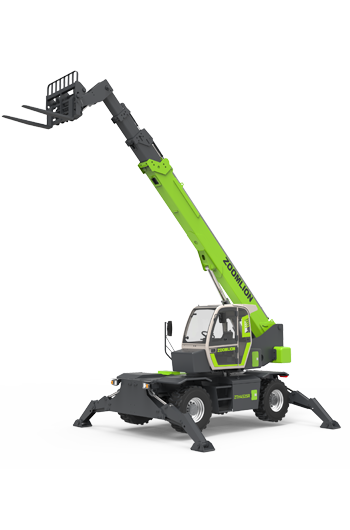
A rotating telehandler can change how material is delivered around a building because the boom can place loads without requiring the entire machine to reposition for every location. For façade installation and multi-level placement, the planning question is not simply how high the machine can lift. Teams also need to consider working radius, placement sequence, ground conditions, load charts, attachments, and access routes.
Why a rotating telehandler suits changing placement points
Traditional material handling often requires repeated movement between pickup and placement positions. A rotating telehandler combines boom extension with upper-structure rotation, allowing the operator to serve different points within the machine’s permitted working envelope from one setup.
That flexibility can be useful on façades where materials need to move from a staging zone toward different elevations or building faces. It can also support multi-level projects where the placement point changes as the structure progresses.
Map the façade before selecting equipment
Begin with a placement map. Mark loading zones, material storage, façade lines, slab edges, access roads, exclusion zones, and the highest and farthest delivery points. Record both the vertical elevation and horizontal distance for each important placement task.
For every load, note its weight, dimensions, center of gravity, and attachment requirements. HSE guidance recommends that telehandler work be properly planned and risks assessed, including load handling, visibility, ground conditions, and machine suitability.
Match reach to the actual placement radius
Maximum lift height alone can give an incomplete picture. A machine may reach a required floor elevation while its available capacity changes as the boom extends forward. Buyers should therefore compare the actual placement radius with the applicable load chart rather than using the headline rated capacity.
This becomes especially important for façade panels, frames, glazing-related materials, insulation packages, or other large components. Their dimensions can affect visibility and stability as much as their weight. Every planned pick should be checked against the manufacturer’s specified configuration and capacity.
Rotation can reduce unnecessary repositioning
The defining benefit of a rotator telehandler is the ability to rotate the upper structure while maintaining the machine’s ground position. On a busy construction site, this can simplify material distribution when several placement points lie around the machine.
However, rotation does not eliminate site-planning requirements. The full swept area, tail swing, elevated load path, nearby structures, workers, vehicles, and overhead hazards still need to be considered. HSE identifies overturning and contact with people as significant telehandler hazards.
Consider multi-level sequencing
Multi-level placement works best when delivery sequence is linked to the construction schedule. Determine which floors or façade zones need materials first, how loads will be staged, and whether the machine can reach the next location without entering restricted areas.
A clear sequence can reduce unnecessary handling. It also helps coordinate telehandler movements with cranes, hoists, delivery vehicles, façade crews, and other trades. Where loads are suspended or moved through occupied areas, appropriate exclusion and control measures are needed.
Ground conditions remain part of the calculation
Rotation and reach do not compensate for unsuitable ground. Check bearing capacity, slopes, uneven surfaces, recently backfilled areas, underground voids, drainage, and changing conditions around the building. HSE notes that rough-terrain telehandlers still have operational limits and require suitable prepared surfaces.
Plan setup points before deliveries arrive. A location that appears workable on a clear site may become inaccessible after scaffolding, barriers, stored materials, temporary roads, or other equipment are installed.
Check attachments and visibility
Attachment selection should be part of the initial planning rather than an afterthought. The attachment changes the load-handling configuration and may affect permissible capacity at different boom positions. Material-handling guidance also requires equipment to remain within manufacturer-rated limits.
Visibility needs attention as well. Large façade loads can obstruct the operator’s forward view, while the boom and rotating upper structure can create changing blind areas. HSE recommends managing pedestrian interaction and using suitable visibility controls or a signaller where necessary.
What the ZTH4525R offers
For projects requiring a larger rotating machine, Zoomlion Access lists the ZTH4525R as a rotating telehandler. Their official specifications state a maximum lift height of 24.8 m, rated capacity of 4,500 kg, lift capacity of 2,000 kg at maximum height, maximum forward reach of 19 m, and lift capacity of 300 kg at maximum reach.
The ZTH4525R also provides 360° continuous rotation, 4×4 drive, hydrostatic transmission, and front-wheel, four-wheel, or crab steering. The published overall dimensions are 9.28 m long, 2.48 m wide, and 3.15 m high, while the machine weight is 17,000 kg.
Build the specification around the project
When discussing a rotator telehandler with Zoomlion Access, provide the highest placement point, farthest forward reach, typical and maximum load weights, load dimensions, attachment type, setup locations, and ground conditions. Their team can then assess the requirements against the appropriate configuration rather than matching the project to a headline capacity.
For façade and multi-level work, also ask them to confirm the applicable load chart, attachment configuration, dimensions for site access, and destination-market documentation. The ZTH4525R figures should be treated as planning references, with the final application checked against the manufacturer’s instructions.
Final checks before deployment
A successful material-placement plan connects four elements: load, reach, elevation, and position. Review them together for every critical pick, then add practical constraints such as traffic routes, pedestrian separation, ground conditions, and changing construction phases.
Used this way, a rotating telehandler can become part of a coordinated material-flow plan rather than simply a machine selected for lifting height. Zoomlion Access offers the ZTH4525R for projects where rotation, reach, and multi-level handling requirements need to be considered together.
