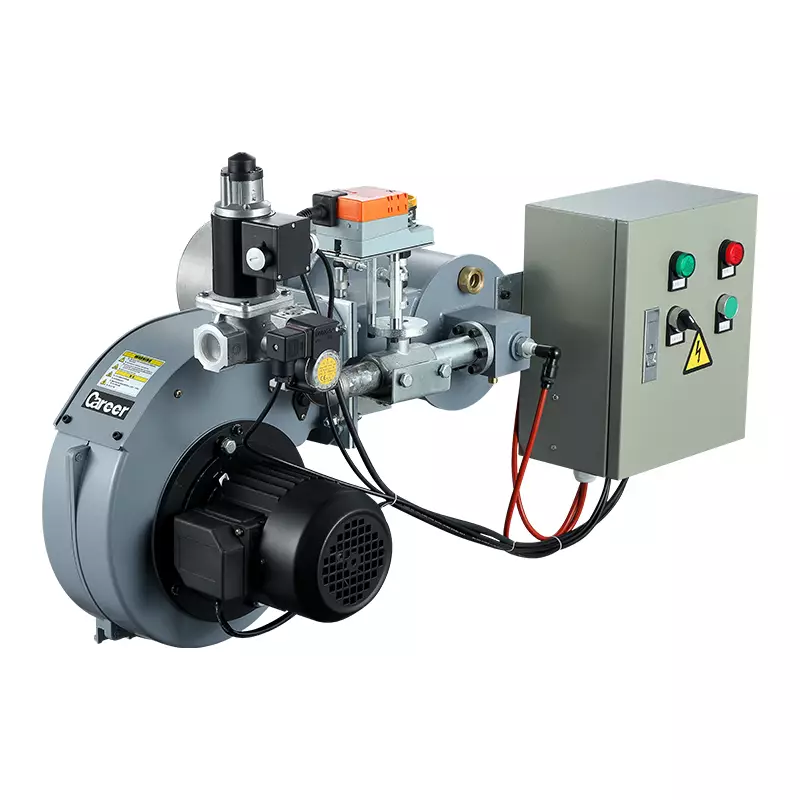
Gas burner turndown becomes important whenever an industrial heating process does not require its maximum heat input all the time. A burner sized for peak demand still needs to operate effectively during periods of lower demand. Turndown describes how much the firing rate declines and maintains the intended combustion operation.
For industrial equipment, that range affects how closely heat input can follow the process. Career Burner’s BX20 provides a concrete example: its published specification gives a 40:1 turndown ratio and continuous modulation, with a stated output range of 5.3–232.2 kW.
Turndown Measures More Than Maximum Output
A turndown ratio compares a burner’s maximum firing rate with its minimum stable firing rate. A 40:1 ratio therefore represents a substantially wider firing range than a burner with a smaller ratio.
Maximum capacity alone cannot show how a burner behaves when the process needs less heat. Two burners could have similar peak outputs while offering very different minimum firing capabilities. Turndown adds the missing operating-range perspective.
That distinction is particularly relevant to a hot air gas burner, where the burner supplies heated process air and its firing rate has to follow a changing thermal load. The process may not continuously require peak thermal input.
Why Variable Heat Demand Makes Turndown Useful
Industrial thermal loads frequently change during production. A heating system may need high output during temperature recovery and considerably less input after the desired operating condition has been approached.
A burner with a broad firing range can reduce its heat input instead of remaining close to its maximum rate. That gives the combustion system more room to follow changing demand through its normal control range.
For a modulating burner, this ability is achieved by adjusting combustion conditions as the required load changes. The BX20 is specified with mechanical continuous modulation, using a servo motor and mechanical linkage for load adjustment.
Turndown should therefore be viewed as a control characteristic, not simply a numerical marketing specification. Its value depends on whether the available firing range corresponds to the process’s actual variation in heat demand.
What a 40:1 Ratio Means in Practice
Career Burner publishes the BX20 with a 40:1 modulation ratio. Its listed natural-gas consumption is 0.55–23.0 m³/h, while output power is specified at 5.3–232.2 kW. The product page identifies the modulation mode as continuous.
Those figures illustrate why the ratio matters. The burner is not restricted to one operating point near its maximum capacity. Instead, its published operating range extends from a substantially lower firing level toward its maximum rated output.
Such a range can be useful where the process load varies rather than remaining fixed. The appropriate minimum and maximum points, however, still depend on the complete installation and its control requirements. Turndown should never be interpreted independently of the combustion chamber, heat-transfer arrangement, fuel supply, and operating strategy.
Continuous Modulation Keeps the Burner Within the Process Window
Continuous modulation differs from a simple arrangement that switches between only a few predetermined firing positions. It gives the control system a means of varying burner output progressively across its designed operating range.
That capability is especially relevant to a hot air gas burner because its heat output has to follow a continuously changing process demand. Matching heat input to the required thermal load can be more useful than repeatedly cycling between high and low firing conditions.
The BX20’s published design combines continuous mechanical modulation with forced-draft air supply and automatic fuel/air flow regulation. Its product information also identifies natural gas and LPG as compatible fuels.
The objective is not necessarily to operate at the lowest possible firing rate. Instead, the useful turndown range is the portion of the burner’s operating envelope that can deliver the required process heat while maintaining suitable combustion behavior.
Turndown Matters Most When Heat Demand Moves Frequently
A wide turndown ratio has its greatest practical relevance when thermal demand varies significantly. Processes that spend much of their operating time near a fixed load may have less need for an exceptionally broad firing range.
Changing process conditions create a different requirement. If demand repeatedly moves between high and low levels, a broad modulation range gives the burner greater flexibility to adjust its heat input.
Career Burner specifies the BX20 as a modulating hot air burner for applications such as textile dyeing and finishing, where its product page describes the burner as suitable for dynamic heat loads. The published 40:1 ratio is therefore directly relevant to its stated operating concept rather than being an isolated specification.
For engineers selecting a burner, the practical question is whether the turndown range covers the real operating profile. Peak capacity determines whether the burner can meet maximum demand; turndown determines how effectively it can remain useful as demand falls.
Matching Firing Range to Real Thermal Demand
Gas burner turndown matters because industrial heat requirements rarely remain constant throughout an entire production cycle. A sufficiently broad operating range gives the combustion system more flexibility to reduce firing input as process demand changes.
The published BX20 specification demonstrates this principle with continuous modulation and a 40:1 turndown ratio. For equipment selection, however, the strongest turndown figure is not automatically the best choice. The useful specification is the one whose firing range aligns with the actual thermal load and operating conditions of the installation.
