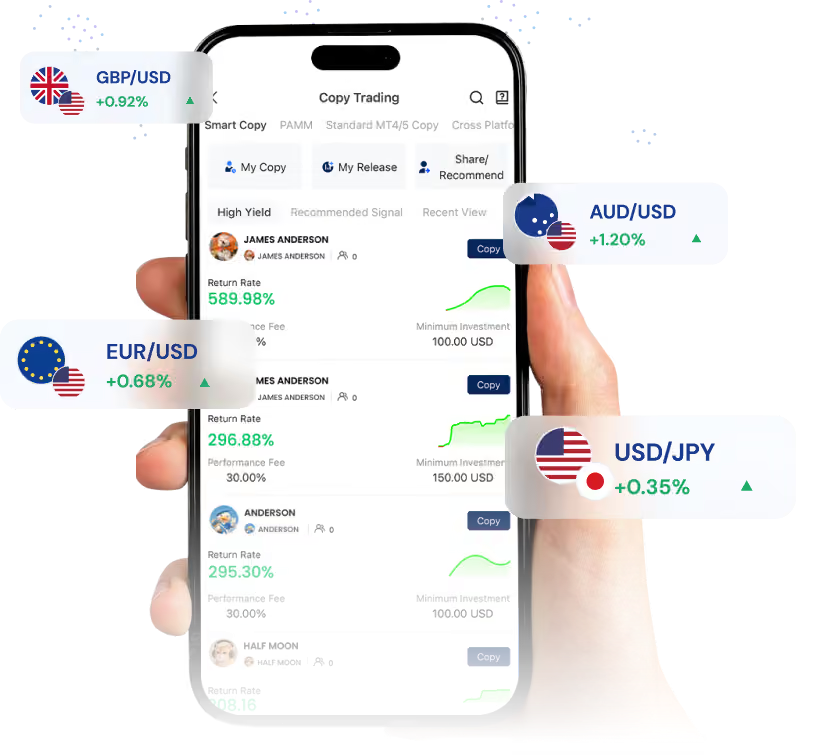
Participating in global financial markets traditionally demands extensive market research, chart analysis, and execution discipline. For individuals seeking exposure without managing individual trades manually, utilizing a copy trading platform provides a practical alternative. Through automated account synchronization, followers can replicate the trading positions of experienced signal providers in real time. However, achieving sustainable results relies heavily on understanding how capital allocation functions. Effective allocation ensures that trade sizes, margin requirements, and risk exposure mirror the master account accurately while staying aligned with the follower’s specific account balance.
The Fundamentals of Capital Allocation in Automated Copy Trading
Capital allocation in copy trading refers to the mechanism that determines how much money from a follower account is assigned to mirror the trades of a selected strategy provider. Rather than opening static trade volumes, modern trading infrastructure calculates position sizes dynamically to preserve proportional risk exposure between master and follower accounts.
When a master trader opens a position, the underlying technology calculates the ratio between the master account equity and the allocated capital in the follower account. If a signal provider opens a trade using two percent of their account equity, the copy trading platform automatically executes a trade in the follower account using the same proportional margin commitment. This proportional calculation protects smaller accounts from over-leveraging while ensuring that gains and losses occur at the same percentage rate across connected accounts.
Key Features in Copy Trading Platforms for Beginners
Navigating automated trading settings can feel overwhelming for market participants who are new to derivative trading. Evaluating copy trading platforms for beginners involves looking for transparent allocation settings, clear performance metric displays, and straightforward user interfaces that simplify capital distribution.
A well-designed platform gives users full visibility and direct control over their capital allocation parameters. Brokers like GTCFX provide intuitive dashboards that display equity growth, maximum drawdown, historical performance, and total assets under management for every strategy provider. Beginners can review these verified performance statistics before committing funds, ensuring that allocation decisions stem from objective data rather than guesswork.
Furthermore, access to flexible order-execution models allows followers to adjust how trades mirror master accounts. Whether allocating a fixed monetary amount, a fixed lot size, or a dynamic percentage of equity, clear configuration controls enable beginners to manage risk without technical friction.
Proportional Allocation vs. Fixed Volumetric Allocation
Understanding the structural differences between allocation models is essential for maintaining control over account equity. Platforms generally offer multiple allocation methods to suit diverse account sizes and trading strategies.
Proportional equity allocation is the standard method used on advanced platforms. Under this model, trade volume adjusts relative to the account balances of both the master trader and the follower. For instance, if the master account holds ten thousand dollars and the follower allocates one thousand dollars, a one-lot order on the master account replicates as a zero-point-one-lot order on the follower account. This system ensures identical percentage drawdowns and returns regardless of account size differences.
Fixed volume allocation allows followers to specify a predetermined lot size for every trade copied, regardless of the volume opened by the signal provider. While this model gives followers greater control over position sizing, it introduces balance mismatch risks. If a master trader scales position sizes based on growing account equity, a fixed lot size may underutilize capital or expose a smaller follower account to excess margin stress.
Fixed ratio allocation permits followers to scale copied trades by a chosen multiplier, such as copying trades at fifty percent or two hundred percent of the proportional volume. This setting allows investors to adjust exposure according to their personal risk tolerance while maintaining proportional balance mechanics.
Risk Controls and Safety Boundaries in Capital Allocation
Allocating capital to a strategy provider does not mean relinquishing oversight of funds. Modern platforms incorporate automated risk parameters that protect capital from unexpected market volatility or sudden changes in strategy behavior.
On GTCFX, users can establish customized risk limits that operate independently of the master trader’s settings. A primary risk control feature is the max drawdown protection threshold, which acts as an automated equity stop-loss. If total losses on a copied strategy reach a specified percentage or monetary limit, the platform automatically halts copy trading, closes open positions, and prevents further equity depletion.
Followers can also limit exposure by setting maximum total open volume caps or capping daily loss limits. Implementing these protective boundaries ensures that account capital remains insulated even if a signal provider experiences an extended drawdown period.
Managing Capital Across Multiple Signal Providers
A fundamental rule of portfolio management is avoiding single-source risk. Allocating all available capital to one master trader exposes the follower account to concentrated operational and strategy risk.
A balanced portfolio strategy involves dividing overall capital among multiple signal providers with non-correlated trading approaches. For example, an investor might allocate forty percent of their capital to a conservative forex day trader, forty percent to a swing trader specializing in precious metals, and twenty percent to a multi-asset index trader. Spreading capital across diverse instruments, asset classes, and timeframes helps smooth equity fluctuations and reduces overall portfolio volatility.
Regular monitoring is necessary to ensure that the portfolio maintains its intended risk balance. Over time, as individual strategy providers accumulate profits or experience drawdowns, their relative weight within the overall account balance will shift. Rebalancing capital periodically re-establishes planned allocation percentages and keeps risk exposure within acceptable bounds.
Infrastructure Quality and Infrastructure Alignment
The technical execution layer plays a decisive role in how accurately capital allocation models perform in real-time market conditions. Even with precise mathematical allocation settings, latency between accounts can lead to execution slippage, causing the follower’s entry price to differ from the master trader’s price.
GTCFX utilizes robust multi-asset execution systems to connect signal providers and follower terminals seamlessly. Minimizing execution delays helps preserve allocation precision across currency pairs, commodities, indices, and derivative instruments. High-quality technology infrastructure ensures that proportional lot calculations translate directly into identical performance curves without structural drag.
Building a Disciplined Allocation Strategy
Understanding how capital allocation works shifts copy trading from a passive speculative activity into a structured asset management approach. By utilizing transparent copy trading platforms for beginners, evaluating signal providers through comprehensive performance data, implementing strict loss boundaries, and diversifying capital thoughtfully across multiple strategies on GTCFX, investors can participate in global financial markets with enhanced discipline, transparency, and risk control.
